BEFORE THE DETAILS
- Give distant viewers one main message and place practical details near the entrance.
- Choose the film after checking the glass, lighting and need to see out.
- Separate permanent information from temporary offers to simplify updates.
1. Map the approach before designing the glass
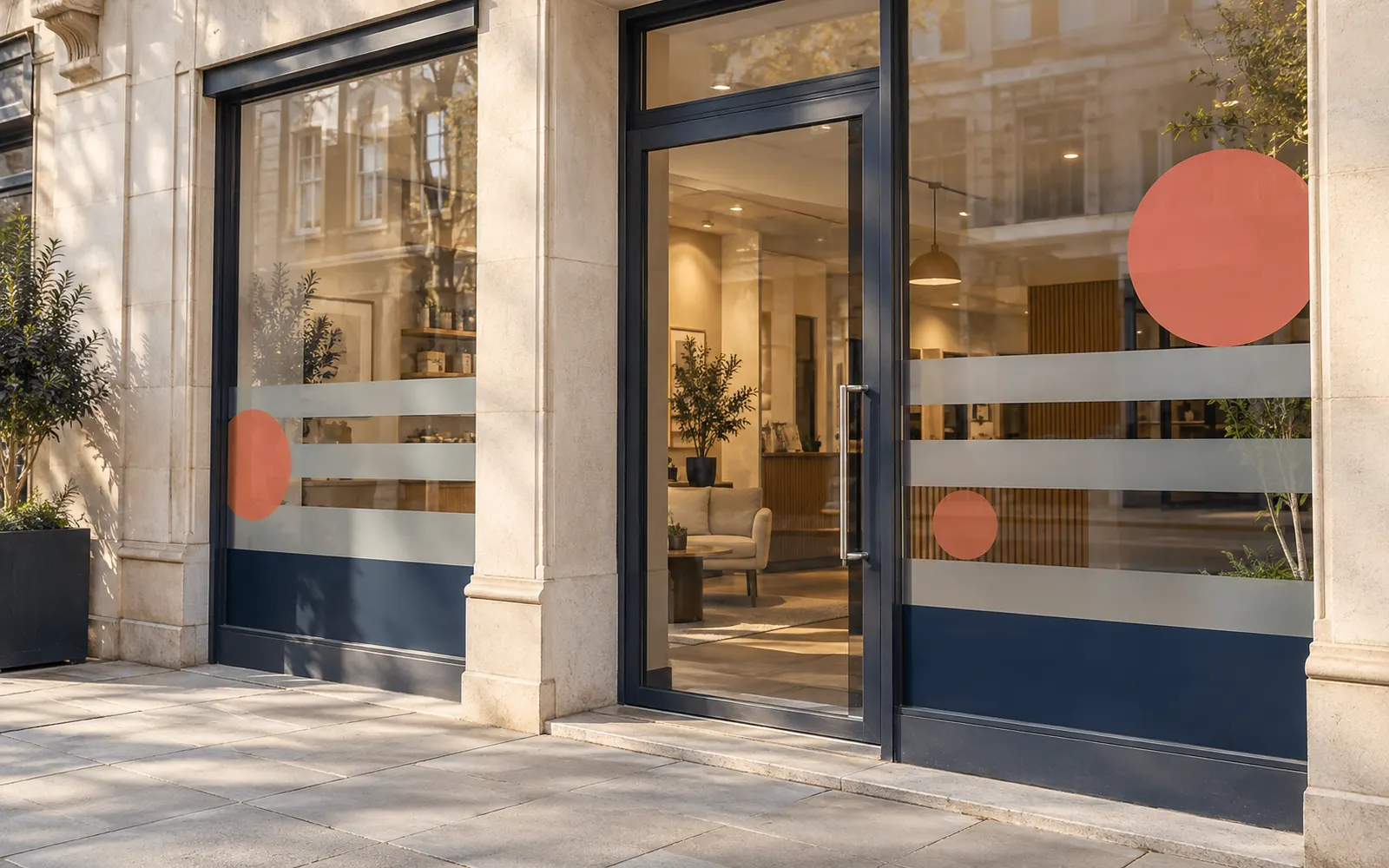
Photograph the directions visitors approach from, then take a close view of each glass panel. Graphics may look clear directly in front of the shop but disappear behind a parked vehicle or column on the approach. Record the door, handle and panel divisions, along with anything inside that should remain visible, such as a product display or reception desk.
Think of the frontage as three moments: recognising the business from a distance, understanding the offer closer up and finding the way in. Every area does not need to serve all three. The upper sign might carry the name, the glazing a product image and the area beside the door the opening hours or entrance direction.
2. Give each area a job and a message
Write the most important message as a short sentence before choosing images. If the aim is to introduce a new service, make its name prominent and add what is needed to understand it. If the aim is to feature a product, use a suitable image with enough space around it. Competing numbers, logos and similar claims make the priority harder to identify.
For bilingual glazing, review meaning and space together. Arabic and English can occupy clearly organised areas or a considered shared hierarchy. Keep essential information in both languages where the audience needs it, and check how phone numbers and opening hours read from outside before approving the file.
| Position | Message purpose | Suitable content |
|---|---|---|
| Area visible from a distance | Quickly identify the business | A name or main service category |
| Glazing close to pedestrians | Explain a reason to visit | A specific product or service |
| Entrance area | Make the next step easy | Opening hours and entrance direction |
3. Balance the message, visibility and material
Compare options by purpose: opaque coverage for a bold message, printing on clear film that leaves parts of the glazing visible, or perforated film for suitable applications. 3M describes one of its perforated films as displaying an exterior image while retaining an outward view from inside. That is a specific product characteristic, not a promise that every perforated film performs identically.
Review a sample on site in daylight and with interior lighting on. Discuss the view you want to retain, fine-detail legibility, display period, cleaning and removal. Descriptions such as “privacy” or “removable” are not enough: ask for the specification and its limitations, and do not treat an advertising film as a substitute for a tested privacy solution.
4. Separate the permanent identity from temporary campaigns
Keep the name and core opening information in a stable area, and leave a space for changing offers and seasons. Updating a date or product then does not require redesigning the entire frontage. Set the campaign’s start and end dates and assign responsibility for removal or replacement so an expired offer is not left on display.
As a planning example for a furniture showroom, the name and product categories can stay fixed while one panel features a seasonal collection with an invitation to view it inside. If you add a QR code, put it where someone can stop and scan safely, and send them to that collection rather than a crowded general page.
5. Review the result from the customer’s position
Before production, approve a layout showing every glass panel, reading direction and panel joint. Check details near handles and door edges, keeping operation and necessary information clear. Agree final measurements and site requirements with the installer, and confirm any required property-owner or site-management approvals.
After installation, review the same approaches you photographed at the start. Check message legibility and whether the entrance is easy to find, then take reference photographs. To assess the campaign, record offer-related enquiries and ask visitors how they heard about it. These observations can guide changes, but they do not establish that the graphics caused every visit or sale.
Common questions
Is full window coverage better for marketing?
It depends on the message and what should remain visible inside. An open view of products may be more useful than additional text. Review the arrangement for the actual frontage.
Can an offer change without replacing all the graphics?
The layout can use separate areas for permanent and changing information. The update method depends on the chosen film and layout and should be agreed before production.
What is needed to quote for window graphics?
Photos, dimensions of each panel, location, display period, intended coverage, available artwork and whether old graphics need removing.
Sources and further reading
YOUR NEXT STEP
Turn the details into a clear brief.
Send frontage photos, glass dimensions and the message you want to feature, and say whether the campaign is permanent or temporary.