BEFORE THE DETAILS
- Test the actual product with all internal packaging components.
- Do not approve graphics placement before folding and closing the prototype.
- An appearance-and-fit prototype does not establish transit performance.
1. Measure the product and define how the pack is used
Start with a physical sample and record its dimensions at the widest points, including projections, handles, lids and accessories. Specify whether dimensions are internal or external: a box that looks suitable outside may not provide enough usable space inside. Include accompanying parts such as a card, insert or protective wrap, then discuss appropriate clearance with the structural packaging designer. Do not assume a fixed allowance solves every product’s requirements.
In a hypothetical Bahla craft business, a ceramic cup and information card need a gift box. Test the handle and insert, not just the cup’s diameter. Also ask whether the box sits on a shelf, is handed over directly or goes inside an outer shipping package, and whether the customer opens it once or closes it again. Those answers define what the prototype must do and prevent confusing presentation packaging with protection in transit.
2. Understand the dieline before decorating it
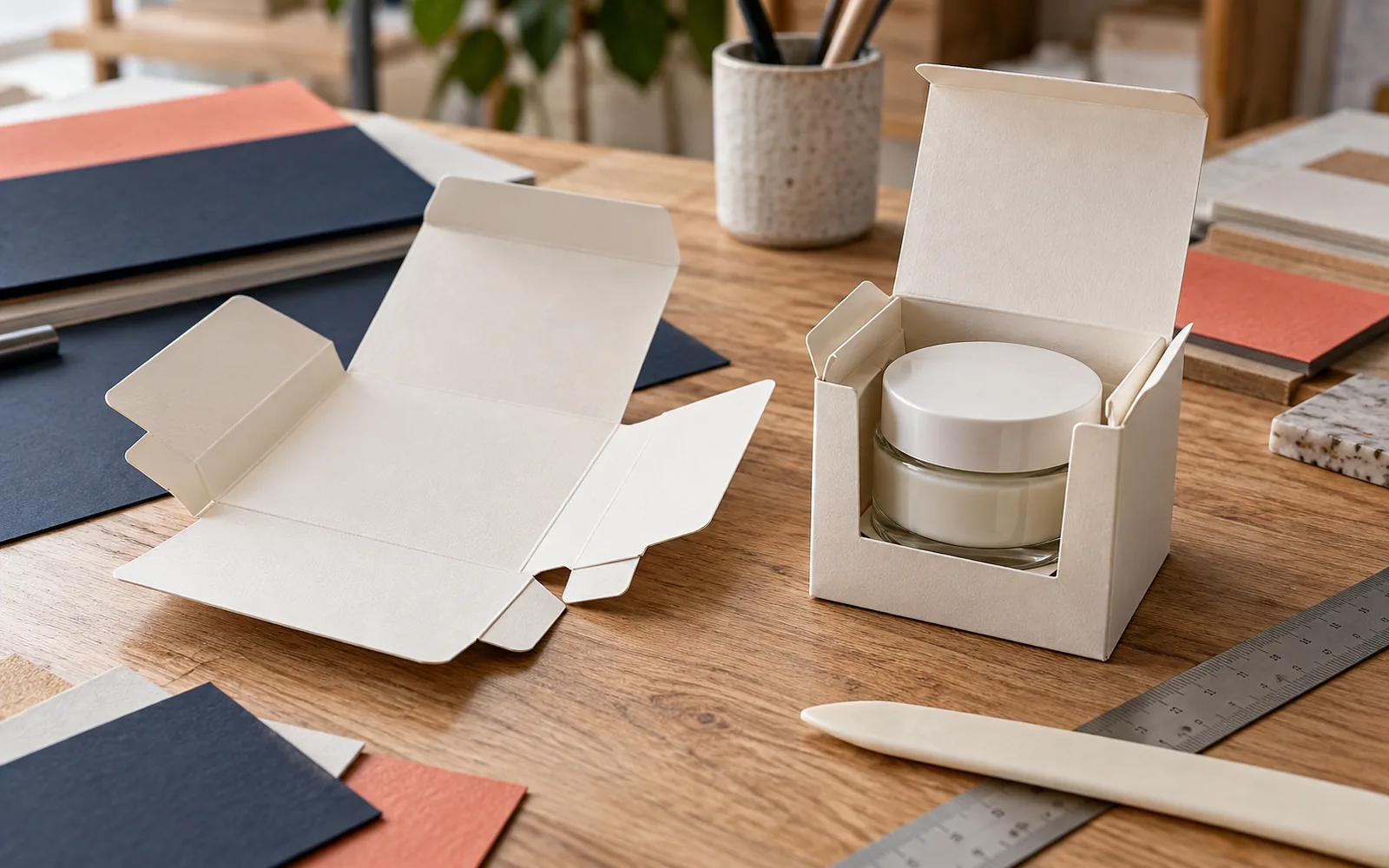
A dieline describes the flat shape and how it becomes a box: panels, flaps, glue areas and closures. Ask for a clear line key and identify inside, outside and lid-opening direction. Label the panels on a trial model, then fold it to check their order. Do not apply an online template directly to the product; dimensions, material and closure need project-specific review.
Iggesund’s handbook explains that creasing creates defined folding lines that help paperboard achieve its intended shape and function. A fold line is therefore more than a drawn mark. Board type, thickness, finish and creasing method need to be reviewed together by the production specialist. If you make an early version from light paper, identify it as an initial layout-and-dimensions test; its easy folding does not establish how the heavier production material will behave.
3. Try packing and closing in the real sequence
Request a full-size prototype in material representative of the decision being tested, recording any difference from the proposed specification. Assemble the box as intended, then insert the support, product and card in the sequence staff will use. Notice where excessive pressure or reopening a completed step is required. Try removing the product as well; difficult access may reveal that an opening which looks tidy does not suit a hand or the contents’ shape.
The cup trial may show the card catching in the closure flap or the handle colliding with the insert. Change one identifiable element and repeat the test with a new version rather than repeatedly altering an old model until it is unclear which configuration worked. Ask someone who did not design the pack to assemble and open it, recording where instructions are needed. Simpler folds or a different card position may help more than another decorative layer.
| Part | Check | What to record |
|---|---|---|
| Internal space | Insert and remove product and accessories | Contact points or unintended empty space |
| Flaps and closure | Open and close as intended | Interference and awkward access |
| Insert | Fit the product without forcing it | Pressure points or movement |
| Packing sequence | Independent trial without the designer explaining | Confusing or repeated steps |
4. Review graphics on the folded object
Once the structure is stable, place text and images on a printed model and fold it completely. Check what customers see first, what remains visible on a shelf and what disappears behind a flap or glue seam. Read Arabic and English from the natural holding position and inspect whether a side heading turns upside down when the lid opens. Do not approve important copy placement from the flat page alone, even if alignment looks precise.
Three-dimensional packaging previews, such as those described by Esko, help review how graphics interact with folds and edges. Use them for visual discussion while retaining the physical sample for questions about fit and handling. Inspect patterns spanning two panels without depending on perfect alignment that cannot tolerate production variation. Give essential information a clear position away from closure areas that may be covered or scuffed when opened.
5. Approve what was tested and identify what remains
Separate structural approval from approval of graphics and final materials. Record the prototype revision, product dimensions, board specification, insert, closure, accepted changes and who approved each aspect. Keep photographs of the sample open and closed with the notes, and a reference sample where possible. If the product, material thickness or closure changes, repeat the affected checks; an unchanged box name does not mean the new version behaves like the previous one.
This prototype does not establish resistance to drops, vibration or shipping conditions. ISTA distinguishes preliminary screening tests from simulations of transport hazards, with selection depending on the objective and distribution route. If transit protection is required, discuss testing the product with its complete packaging through an appropriate provider rather than turning a brief carrying trial into a guarantee. Clarify any product-specific requirements with its supplier before approving materials that contact it.
Common questions
Is a 3D image enough to approve the box?
It helps with appearance and graphics placement, but does not let you physically try insertion, closing and opening. Choose a representative physical sample for the aspects you need to verify.
Can office paper be used to try the dimensions?
It can help explain panel arrangement and initial proportions, provided its limitations are recorded. It does not represent production-board thickness, stiffness or final fold and closure performance.
Sources and further reading
YOUR NEXT STEP
Turn the details into a clear brief.
Share the product, dimensions, pack contents and delivery method so we can discuss packaging-design scope and the sample needed before production.