BEFORE THE DETAILS
- A plotter follows a cut path, so the artwork needs workable outlines.
- Registration marks relate the printed image to its cutting path.
- Small-letter detail, weeding and application are part of quality.
1. What does a cutting plotter do?
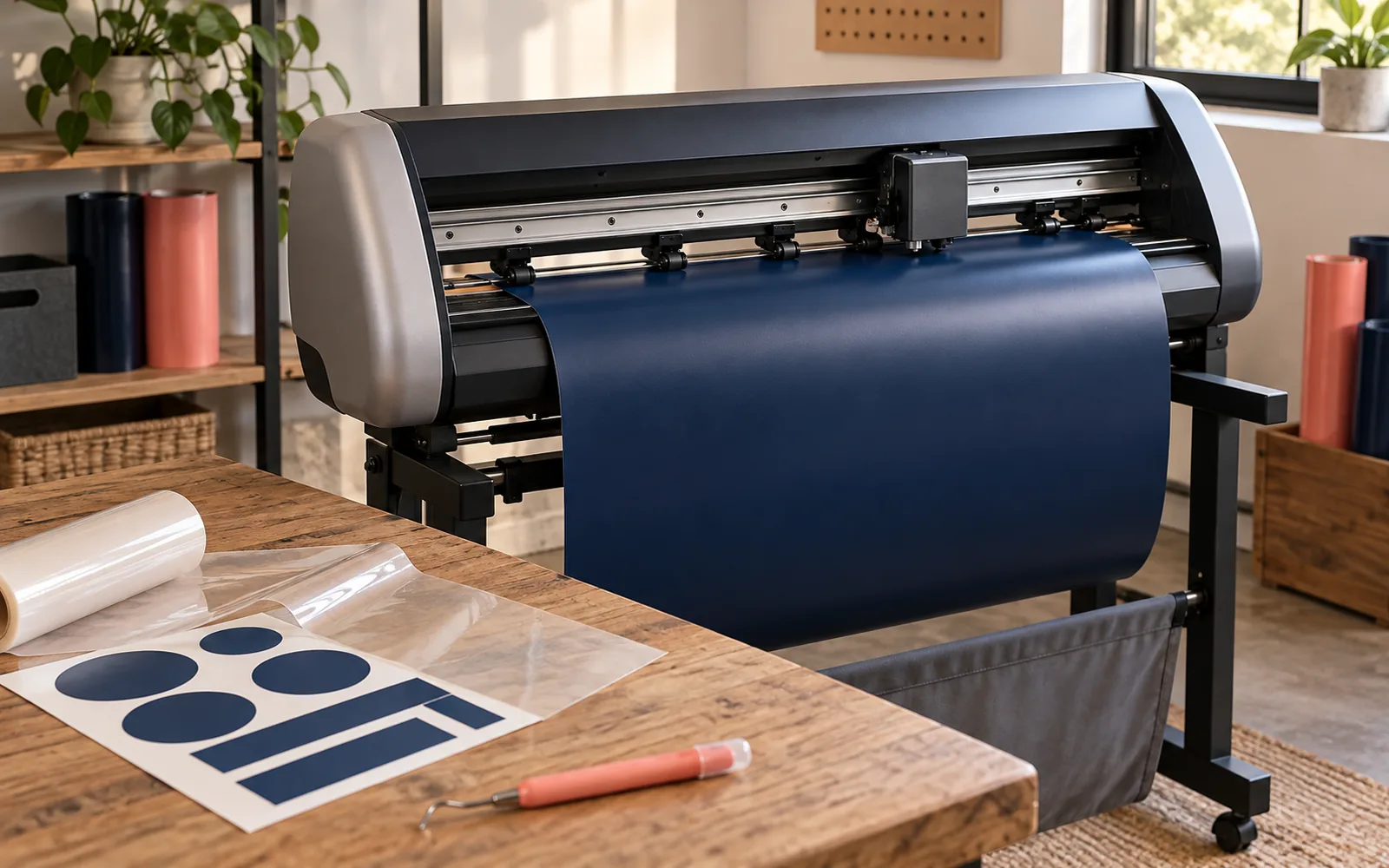
The blade carriage and media movement follow lines defined in the file. For coloured vinyl lettering, the colour comes from the material itself, and unwanted areas are removed in the weeding stage. Suitable application tape can preserve letter positions during installation. A multicolour image needs printing before cutting, or a workflow combining the two processes.
Cutters differ in media width, tools and supported materials. Some systems combine printing and cutting; others use separate machines. For the customer, the important distinction is the intended product: lettering transferred to glazing, stickers supplied on a backing sheet, or individual pieces. Do not assume a roll cutter is also intended for rigid acrylic boards.
2. Kiss-cutting and through-cutting
Kiss-cutting cuts the sticker layer while leaving its liner able to carry it, so the sticker can be peeled later. Separating a sticker with its backing requires a method supported by the machine, potentially using perforation or small connecting bridges depending on the system. Name the required result and send an example: asking only for cutting can lead to a different delivery format than expected.
Protective lamination adds a layer and changes the print construction, so include it in the final cutting test. The operator checks media, tool and separation-method support against the machine manual. There is no single cutting pressure for all vinyls; arbitrary increases can affect the liner, cutting strip and edge quality.
| Requirement | Intended result |
|---|---|
| Vinyl lettering | Waste removed and letters prepared for transfer |
| Stickers on a sheet | Cut outlines with a liner carrying the stickers |
| Individual stickers | Shape and backing separated using a supported method |
3. Cut paths and registration marks
Vector artwork describes shapes using lines and curves. A logo inside a PDF is not necessarily vector; it may be an embedded image. Ask for the cutting path to be separated from the artwork, appropriate paths to be closed and duplicate lines removed. Keep an editable version and check Arabic letterforms before converting text to outlines where required.
For contour cutting around a printed image, a sensor or camera reads registration marks to locate the artwork. Marks must be generated for the chosen workflow, with enough space for detection. Do not trim the margins or resize the print after preparation without review, because the cut file may no longer match. Lamination must also be coordinated with mark reading and cutting.
4. Small details need a physical sample
A very thin stroke or tiny dot can look clear on screen but become difficult to weed or transfer. For Arabic, inspect dots, gaps between elements and counters inside letters. Request a full-size sample including the finest detail. If it is impractical, enlarge or simplify it, or consider a printed graphic instead of making every element a separate vinyl shape.
Also review the edge of a printed sticker. Artwork extending beyond the cut path can help avoid an unprinted sliver if there is minor variation, with the bleed defined for the workshop’s requirements. Assess the sample as the customer will receive it: peelability, orientation, sticker count per sheet and arrangement. Do not judge the path only on screen.
5. The order brief and cutter care
Blade and cutting-strip condition and media-path cleanliness are maintained according to the machine manual, and cutting quality is rechecked when media changes. Trained operators handle blades and moving components; faults require appropriate technical support. Adhesive selection depends on the application surface, service period and removal requirements. A clean cut alone does not establish suitability for the location.
- Finished dimensions, quantity and required delivery format.
- Coloured vinyl or a printed graphic, and whether it will be laminated.
- Logo and cut path if available, with a sample of fine lettering.
- Application-surface photograph, viewing direction and intended service period.
Common questions
Can a phone image be cut directly?
It can be a reference, but the machine needs a clear path. A logo may require redrawing or separate outlines, which should be reviewed before quotation and production.
Can every plotter cut a sticker through its backing?
Do not assume this capability. It depends on the model, tool, media and approved cutting method, and must be confirmed before ordering individual stickers.
Sources and further reading
YOUR NEXT STEP
Turn the details into a clear brief.
Send the logo, dimensions and quantity, and specify transfer lettering, stickers on a sheet or individual pieces.